As deadly anti-government protests continue across Iran, the impact is felt by Australia‘s Iranian community, with concerns for the safety of their friends and families as the death toll continues to escalate.
Hengaw Organisation for Human Rights, a group based in Norway, estimates that more than 2500 people have been killed in the protests, which began two weeks ago.
Internet access was cut off in the country by the government, making confirmation of events or the number of people detained or killed difficult.
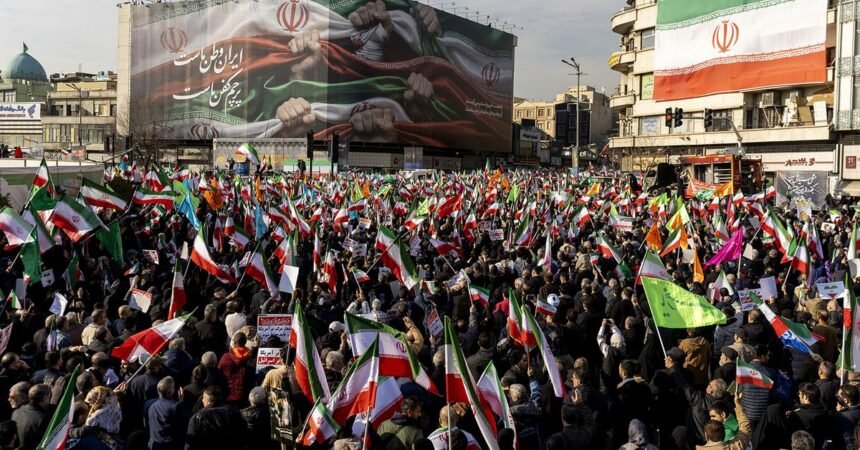
People gather during protest in Tehran, Iran. (Getty)
Amir Madadi, from Ryde in Sydney’s north-west, learned a close relative had been shot in the chaos.
”That relative is still alive, he [is] still alive. Bad injury,” Madadi said.
Amir Madadi from Ryde in Sydney learned a close relative had been shot in the Iranian protests. (Nine)
Others are not so lucky. Lawyer and Iranian human rights advocate Sara Rafiee remains in the dark when it comes to her family.
“I have not been able to contact them. I don’t even know if they [are] dead or alive. It’s the hardest thing not knowing,” Rafiee said.
She says she knows that a massacre is being played out in the country where she was born.
“The latest report is that they are using military-grade machine guns and they are just shooting at protesters,” she said.
Rafiee shared a voice message from inside Iran, capturing a rare account of the civil unrest.
”She is saying, ‘what you are seeing on the news or social media is only 2 per cent of what is actually happening on the ground’.”
Sara Rafiee is a Lawyer and Human Rights Advocate. (Nine)
As a brutal regime maintains its grip on the nation, both Madadi and Rafiee agreed that US President Donald Trump was the person people were looking to for direct action.
“Donald Trump, he needs to step in, obviously,” Madadi said.
Kambiz Razmara, vice president of the Australian Iranian Society of Victoria, described the experience of watching what was happening from afar as like a “malignant cancer”.
“It feels like on the one hand, you feel like this tumour can kill,” he told 9news.com.au.
“So you lose hope, you panic, you cry.
“On the other you say, ‘well, we can get treatment. We are resilient. We will fight it. There is hope’.
“And you hope, and you move forward.”
Razmara, a lawyer involved with some human rights issues, said the process was exhausting and the emotions overwhelming.
“The mental health impact of this on our community is excruciating,” he said.
“It’s such a terrible, terrible sort of thing when, especially, when you can’t communicate to loved ones, and that is the experience of a lot of our community members.”
Razmara said this uprising felt different to previous modern protest movements in Iran, and he was hopeful it would lead to regime change.
A crowd gathers in Iran during the protests. (Getty)
“We say it with a great deal of reservation, but we think … it can’t get any worse,” he said.
“We just want rid of these people. They have no legitimacy in Iran.”
Razmara called on the Australian government to advocate for human rights in Iran and, in the short term, for the internet to be restored.
He also wanted targeted sanctions to be imposed and for resources to teach the Iranian community “how to engage with democracy and exercise democracy”, to increase social cohesion.
Members of the Iranian community were planning a vigil outside the Victorian parliament for 7pm today.