

Daily London
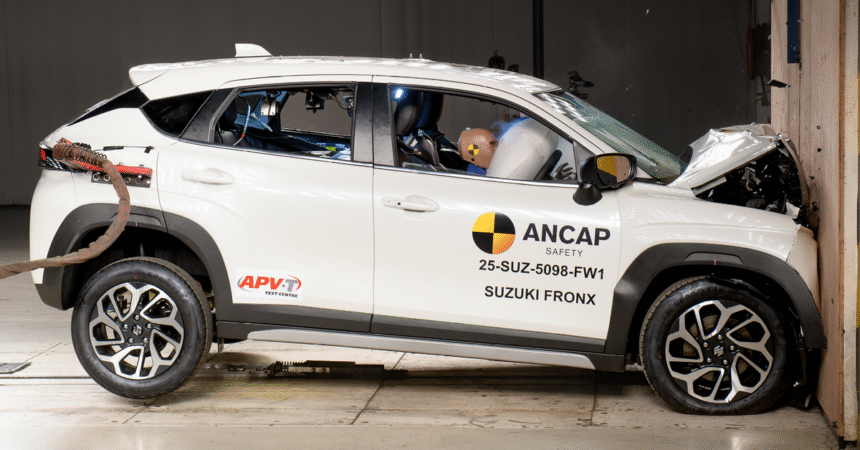
The Suzuki Fronx, which went on sale in Australia in August this year, has a serious fault with its seatbelts and performed poorly in crash tests, according to a report by ANCAP.
Testing revealed that in a head-on collision, the rear passenger seatbelt retractor failed, resulting in it releasing and sending effectively unrestrained test dummies headfirst into the front seat.
However, ANCAP highlighted the car had already failed the crash test due to the dummies in the rear passenger seats having too much force placed against their chest.
Testing of dummies mimicking a six-year-old and 10-year-old child also recorded excessive neck tension and high head acceleration.
As a result, the Fronx received zero points in the test.
It only received a score of 48 per cent in adult occupant protection and 40 per cent in child occupant protection, with the latter barely meeting the criteria for a one-star rating.
“The one-star rating reflects the Fronx’s overall crash performance – particularly the performance of its structure and restraint systems – and is not a consequence of the separate seatbelt component failure,” the report said.
Around 1300 Fronx cars have already been sold in Australia.
ANCAP has urged Suzuki to investigate and fix the problems, and said until this happened, it could not recommend passengers travel in the car.
“ANCAP’s view is that adult and child passengers should not travel in the rear seats of the Suzuki Fronx,” ANCAP CEO Carla Hoorweg said.
“The seatbelt component failure is rare and serious… what concerns us is that this particular vehicle could have been purchased by an ordinary consumer, and in an on-road crash this failure could have had serious consequences for the person sitting in the back seat.”
Suzuki Australia said it takes the report seriously.
“A thorough and disciplined investigation is underway, and Suzuki will take any actions required to uphold our safety standards and the trust our customers place in our brand,” the company said in a statement.
“This review is being progressed with urgency and at the highest levels of the organisation.”